
Scoliosis is a condition where the spine curves sideways, with vertebral rotation, resembling the letter C or S. A diagnosis is confirmed when a standing X-ray shows an angle of at least 10 degrees.
Scoliosis appears most often during the growth spurt before puberty, between the ages of 10 and 15. It affects male and female adolescents, although girls are at greater risk. A small curve may cause no pain or functional problems. However, larger or progressive curves may affect alignment, comfort, breathing and body image.
What Is Scoliosis?
When viewed from behind, a typical spine appears relatively straight. With scoliosis, the spine curves sideways and the vertebrae may rotate. This curvature varies by location and severity.
The curve may affect the:
- Thoracic spine in the upper or middle back
- Lumbar spine in the lower back
- Thoracic and lumbar regions
For scoliosis affecting the thoracic or lumbar regions, these cases may be called thoracic scoliosis or lumbar scoliosis, respectively. When both regions are affected, it is called thoracolumbar scoliosis.
Scoliosis Symptoms
Common signs and symptoms of scoliosis include:
- Uneven shoulders
- One shoulder blade appearing more prominent
- One hip sitting higher than the other
- An uneven waist
- The head appearing off-center
- The body leaning to one side
- A rib prominence when bending forward
- Clothes hanging unevenly
Symptoms of scoliosis vary. Mild scoliosis often causes no pain. Stiffness and discomfort are more common in adults with scoliosis, particularly when the curve is associated with age-related changes in the spine. Adolescents may also feel self-conscious about changes in posture, body shape or brace use.
Severe scoliosis may reduce space for the lungs as the rib cage shifts, making breathing more difficult. However, these complications of scoliosis are uncommon.
Types and Causes of Scoliosis
Many myths surround scoliosis causes. You do not develop scoliosis from poor posture, carrying a heavy school bag, sports or physical activity, sleeping position, food, or vitamin supplements. The main types of scoliosis are idiopathic, congenital, neuromuscular, degenerative and early-onset. These vary based on their development and the scoliosis causes that lead to the condition.
Idiopathic scoliosis
Idiopathic scoliosis has no known single cause and often appears during adolescence. Scoliosis can run in families, suggesting genetic factors may contribute, although many children have no family history of scoliosis.
Congenital scoliosis
Congenital scoliosis is present from birth and develops when one or more vertebrae do not form normally before birth. It may also occur with other congenital birth defects.
Neuromuscular scoliosis
Neuromuscular scoliosis occurs with conditions that affect the nerves or muscles supporting the spine, such as cerebral palsy or muscular dystrophy. For example, cerebral palsy may cause weakness or a muscle imbalance that affects the spinal curve.
Degenerative scoliosis
Degenerative scoliosis develops later in life as discs and spinal joints change with age. It commonly affects the lumbar spine and may occur with lumbar spondylosis, spinal stenosis or other degenerative conditions. This type may involve joint disease or bone degeneration.
Infantile and early-onset scoliosis
Infantile scoliosis appears before age 3. Juvenile scoliosis develops between ages 3 and 10. Early-onset scoliosis refers to curves that appear before age 10. These types of scoliosis require specialist medical assessments because the spine and chest are still developing.

How Scoliosis Is Diagnosed
A parent, teacher, school nurse, doctor, or physiotherapist may first notice scoliosis in children. A medical professional uses a physical examination and imaging to confirm and diagnose the condition.
During an examination, the clinician checks the shoulders, shoulder blades, waist, hips, and the patient’s overall balance. They may conduct the Adam forward bend test to see if a rib or trunk prominence becomes visible. However, this is a screening test, and not a diagnosis.
If a medical practitioner suspects scoliosis, they may arrange a standing scoliosis X-ray. Doctors diagnose scoliosis using the Cobb angle, a mathematical method for measuring the spinal curve. A Cobb angle of at least 10 degrees supports the diagnosis.
Magnetic resonance imaging (MRI) or other imaging may be needed if there is unusual pain, weakness, numbness, neurological symptoms or an atypical curve pattern.
In Singapore, NUH reports that adolescent idiopathic scoliosis affects about 1.4% of schoolgirls aged 11 to 12 and 2.2% of schoolgirls aged 13 to 14. These figures should not be interpreted as applying equally to every population, and every case must be treated differently.

Scoliosis Treatment
Scoliosis treatment depends on:
- Age
- Curve type and location
- Cobb angle
- Skeletal maturity
- Whether the curve is progressing
- Symptoms and daily function
- Other medical conditions
| Treatment | When it may be considered |
| Observation | Mild or stable curves, commonly below 25 to 30 degrees |
| Scoliosis brace | A growing child or adolescent with a curve generally above 25 degrees and below 45 to 50 degrees |
| Physiotherapy and prescribed exercises | To address strength, movement, postural control, breathing, pain and physical activity |
| Casting | Selected cases of infantile or early-onset scoliosis |
| Scoliosis surgery | Curves commonly above 45 to 50 degrees, progressive curves or curves causing significant health or functional concerns |
These ranges are general guides. The patient’s age, remaining growth, and progression will be considered when choosing the appropriate treatment.

Observation
Not all small or stable curves require treatment. Growing children may need periodic physical examinations and standing X-rays. Risk factors include the remaining growth and a larger curve at diagnosis.
Scoliosis bracing
A scoliosis brace may be prescribed for moderate scoliosis in a growing child or adolescent. Brace treatment aims to slow curve progression and reduce the risk of worsening. It does not usually reverse an existing curve.
Brace selection and wearing time will be determined by an orthopedic specialist and orthotist.
Scoliosis surgery
Surgical treatment for scoliosis may be considered for a large or progressive curve, particularly when growth remains, or the curve affects health and function.
Spinal fusion is the most common surgical treatment for scoliosis. During spinal fusion, modern spinal instrumentation uses rods and screws to hold the spine while bone graft material supports fusion. The bone graft gradually joins selected vertebrae, correcting the scoliosis curve. An orthopedic spine surgeon assesses the suitability of the patient.
Post-surgical physiotherapy may later help restore mobility, strength, and function, following the surgeon’s precautions.
Physiotherapy for Scoliosis
A physiotherapist can screen for signs of scoliosis, assess how the condition affects the movement and refer for medical evaluation when imaging or specialist care may be needed.
A scoliosis physiotherapy assessment may include:
- Posture and trunk alignment
- Spinal and limb mobility
- Muscle strength and endurance
- Balance and movement control
- Breathing mechanics
- Pain and activity limitations
Conservative treatment options may include physical therapy with prescribed scoliosis exercises to improve trunk and abdominal strength, postural control, breathing, mobility, and confidence with activity. Selected exercises are based on the curve pattern, age, symptoms and treatment plan. Do these with proper guidance rather than attempting them on your own. A proper plan should also be progressive and adjust as your condition changes.
Physiotherapy does not replace medical monitoring or bracing when these are indicated. Exercise programs cannot straighten the spine curve or reliably stop progression. They do not treat scoliosis by eliminating the curve; they address pain and movement problems.
Clinical Pilates for scoliosis
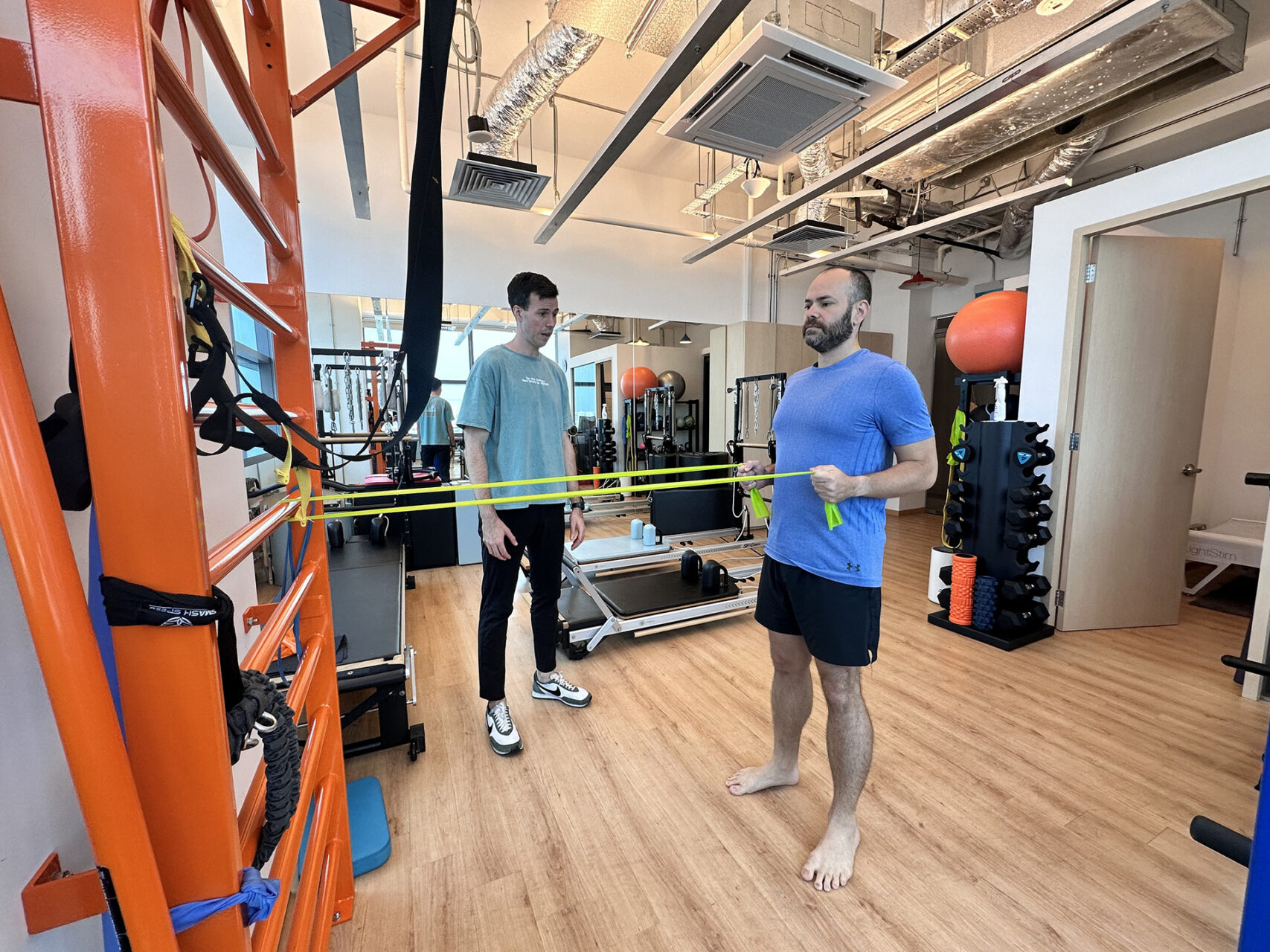
Clinical Pilates may be adapted to develop trunk strength, body awareness, balance and movement control. Pilates for scoliosis should be individualized rather than based on a standard exercise routine, as every case varies.
Manual therapy
Manual therapy may help with associated stiffness or muscular discomfort. It may make exercise more comfortable, but it does not correct the scoliosis curve or change the Cobb angle.
Scoliosis in Children and Adolescents
Most adolescent scoliosis is idiopathic. Scoliosis most often affects children during rapid growth. Early identification from a specialist helps determine whether monitoring or bracing is appropriate.
Children with suspected scoliosis should receive a medical assessment, even without pain. Pediatric physiotherapy may support movement, strength and physical activity as part of a broader care plan.
Most scoliosis patients can lead normal and independent lives. Address your child’s concerns about appearance, clothing, sports participation, or brace use, as this support can protect confidence and body image.
Scoliosis in Adults
Adults may have a curve that began in adolescence or degenerative scoliosis that developed later in life. Symptoms of scoliosis for adults may include lower back pain, stiffness, fatigue, reduced walking tolerance or pain extending into a leg.
Scoliosis treatment in adults focuses on function, general health and curve progression. Treatment options include exercise, physiotherapy, pain management or specialist care. Surgery is considered for severe symptoms, neurological problems or inadequate function after conservative treatment.
When to Seek Medical Assessment
Arrange an assessment if you notice:
- Uneven shoulders, ribs, waist or hips
- A visible curve or trunk lean
- A rib prominence during forward bending
- A change in spinal alignment during growth
- Persistent or worsening back pain
- Reduced walking tolerance
- Numbness or weakness in an arm or leg
Seek urgent medical care for new bowel or bladder changes, significant limb weakness, loss of sensation around the groin, severe unexplained pain or breathing difficulty.
Living With Scoliosis
Most people with small curves can remain active and participate in exercise and sport. Activity does not cause idiopathic scoliosis.
You may need to adjust your activity plan if you have pain, a progressive curve, a brace, or recent surgery. Base guidance on your symptoms, medical recommendations, and physical goals.
Scoliosis Assessment at HelloPhysio
If scoliosis or related back pain affects your movement, exercise or daily activities, a physiotherapist can assess your strength, mobility, and function. If you are looking for scoliosis treatment in Singapore, contact HelloPhysio for a tailored plan.
If scoliosis is suspected but not medically confirmed, the physiotherapist may recommend further evaluation or imaging. Contact HelloPhysio to arrange an assessment at the Orchard or Raffles Hotel Arcade clinic.
Frequently Asked Questions
Can poor posture cause scoliosis?
No. Poor posture may change how you sit or stand, but it does not cause structural scoliosis.
Is scoliosis genetic?
Scoliosis may run in families, particularly idiopathic scoliosis. However, many diagnosed with scoliosis have no known family history.
Can exercises straighten scoliosis?
Exercises may improve strength, movement, breathing, postural control and symptoms. They should not be expected to eliminate a structural spinal curve.
When is a scoliosis brace needed?
A brace may be considered when a child or adolescent is still growing and has a moderate or progressive curve. The decision depends on the Cobb angle, skeletal maturity and risk of progression.
When is scoliosis surgery considered?
Surgery may be considered when a curve is large, continues to progress or causes significant health or functional concerns. An orthopedic spine surgeon should make this assessment.