

|
Getting your Trinity Audio player ready...
|
What Is the Difference Between a Sprain and a Fracture?
A sprain is a ligament injury where ligaments are partially torn or completely torn. A break is a fracture of one or more bones or a broken bone in the ankle joint. A rolled ankle can be scary because while swelling and bruising show up fast, it is hard to know what you are dealing with in the moment. The question of a sprained ankle vs a broken ankle is one of the most frequent we hear about ankle injuries. Both sprained and broken ankle injuries can cause significant pain, intense pain, swelling and bruising. Both can lead to long-term problems if not properly treated.
Ligaments are tough bands that help hold the ankle joint together. A sprained ankle injury occurs when the foot twists, stretching or tearing the ligaments. An ankle fracture occurs when force exceeds the bone’s tolerance, resulting in a fracture.
In real life, the pain threshold is not always an obvious indicator of the condition. A severe sprain can hurt as much as a broken ankle, and its severity does not always match its appearance. A stable minor fracture can feel like a badly sprained ankle at first.
It is key that you know you cannot always tell at home whether it is a chronic ankle sprain or a fracture. A proper exam by a healthcare professional and, when indicated, an X-ray are the safest ways to get an accurate diagnosis. A physiotherapist can assess movement, ankle swelling and stability, then guide you on whether you should be referred for imaging and medical review.

How Do These Injuries Usually Happen?
Sprained ankle and broken ankle injuries usually differ in mechanism. A sprained ankle usually occurs from a twist or roll, while a broken ankle is more likely to result from higher-force trauma or a heavier twist under body weight. A sprained ankle often occurs when your foot twists inward, straining the outer ankle ligaments, such as when you land awkwardly, step off a curb, or change direction quickly in sports.
A broken ankle is more likely to occur after a fall, a direct blow, a car accident, or a forceful twist that compresses the ankle joint, such as in contact sports. In Singapore, we often see these ankle injuries from quick direction changes on court surfaces or a misstep on stairs at an MRT station during the morning rush.
Sprained vs Broken Ankle Symptoms
Symptoms of a broken ankle and a sprain include swelling, bruising, and severe pain. The two conditions tend to differ most in where the pain sits, how much weight you can bear, and whether the ankle looks out of position.
With a sprained ankle, pain is often centered in the soft tissue around the ankle, especially on the outside, where ligaments commonly tear. Swelling and bruising may be moderate to significant, and bruising can spread over time. Many people with minor sprains can take a few steps, even if it is uncomfortable.
With a broken ankle, pain is more likely to be pinpointed over the ankle bone. Swelling is often rapid and intense, and bearing weight on the affected foot may cause more severe pain or may even be impossible. Difficulty putting weight on the injured ankle is a key sign. An ankle that appears misaligned raises concern for a displaced fracture or dislocation. Seek medical attention immediately if this is the case with your ankle.
People describe a “pop” with both sprained and broken ankle injuries, making it unhelpful for distinguishing between the two. The more useful sign is what happens next. Sudden and severe pain, the inability to push off, and the immediate loss of function may suggest a broken ankle or a severe injury.

Hairline Fracture vs Sprained Ankle Symptoms
A hairline fracture is a small crack in the bone, often stable and non-displaced. A hairline fracture vs a sprained ankle can be hard to separate without imaging because the pain, swelling and bruising may be similar, especially early on. Some people can still walk on an ankle with a hairline fracture, particularly if adrenaline is high or the fracture is small.
Clues that may point toward a hairline fracture include very localized bony tenderness, pain that does not improve after a few days, and pain that spikes when putting weight on the ankle, even after the swelling settles. A tingling sensation may also occur. Sometimes, initial X-rays do not clearly show a tiny fracture, and repeat imaging is needed if symptoms do not follow a typical recovery from a sprained ankle.
When Should You Seek Urgent Care?
Seek medical attention immediately if you cannot bear weight on the injured ankle, the affected foot looks deformed, or you have numbness, a tingling sensation, an open wound, or rapidly worsening swelling. These are situations where a broken ankle must be ruled out quickly.
How Clinicians Decide Whether You Need an X-ray
Clinicians often use a structured exam to decide whether imaging is needed, since not every ankle injury requires an X-ray. If pain is centered over the ankle bone, you cannot bear weight, bearing weight on the affected area is very difficult, or the injured ankle looks abnormal, imaging is more likely to be helpful.
The most common imaging test is an X-ray to assess for an ankle sprain vs fracture. If a broken ankle is suspected or the ankle joint alignment is unclear, a healthcare professional may recommend additional imaging, such as a CT or MRI.
Sprained Ankle vs Broken Ankle Treatment
What does treatment look like for a sprain?
Most sprained ankle injuries recover well with the right protection early and a progressive treatment plan that restores strength and balance. Mild sprains often improve within a couple of weeks, while severe sprains can take six to eight weeks to regain full support and confidence. Severe sprains, where ligaments are severely damaged, may require a longer recovery. A healthcare professional will recommend physical therapy to ensure proper healing.
Early care focuses on protecting the sprained ankle from repeated rolling, minimizing swelling, and maintaining safe movement. As the pain settles, the focus will shift to strengthening the calf and peroneal muscles, improving ankle mobility, and retraining balance and reaction time. Physical therapy and prescribed at-home exercises rebuild the ankle sprain patient’s capacity to avoid recurrence.
What does treatment look like for a broken ankle?
A broken ankle involves immobilization and sometimes surgical intervention, followed by rehabilitation to restore motion, strength and walking mechanics. Stable broken-bone injuries may be treated with a boot or a cast. Severe fractures and displaced fractures may require surgical intervention to realign the broken bones and stabilize them, followed by a period of immobilization before rehab can begin.
Proper healing requires physical therapy. That is where physiotherapy becomes essential for the ankle. Even after the bone heals, stiffness and weakness can linger, especially after long-term immobilization. Rehab helps restore ankle range of motion, rebuild calf strength, and retrain balance so you can return to daily life and sport safely. Without rehabilitation, the ankle fracture may not heal correctly.
What to do in the first 48 hours
In the first 48 hours, protect the ankle, minimize swelling and avoid activities that provoke sharp pain while you plan the right next step. If you suspect a broken ankle, do not push through. Limit weight-bearing on the affected foot; do not bear weight if it causes intense pain; use a supportive wrap or ankle brace if available; and seek medical attention for an accurate diagnosis and careful treatment.
For sprained ankle injuries, a modern approach is PEACE and LOVE: protect the affected area, elevate, use compression to reduce swelling, and keep gentle movement within tolerance, then gradually reload with strengthening as symptoms allow. The goal is not to eliminate all discomfort immediately. The goal is to avoid repeated aggravation while you set up a progressive recovery and treatment plan.
How physiotherapy helps, and how modalities fit in
Physiotherapy helps most by restoring mobility, building strength, and retraining balance so your ankle is stable under real-life demands. At HelloPhysio, we start by clarifying which ankle structure is likely injured, which movements trigger pain, and whether you need a referral for imaging.
Prescribed exercises are the foundation. They improve calf strength, ankle control, and proprioception, reducing the risk of recurrent ankle sprain injuries and helping prevent chronic ankle instability. This is true whether you are recovering from an ankle sprain or returning after a fracture in a boot. Avoid putting weight on the ankle until your clinician clears you.
Adjunctive therapies can support recovery when they help you tolerate loading and move better as you work with your physiotherapist.
- INDIBA® may be used to support comfort when swelling and stiffness limit early movement.
- Dry Needling can help when calf or peroneal muscle guarding limits ankle motion or keeps pain reactive.
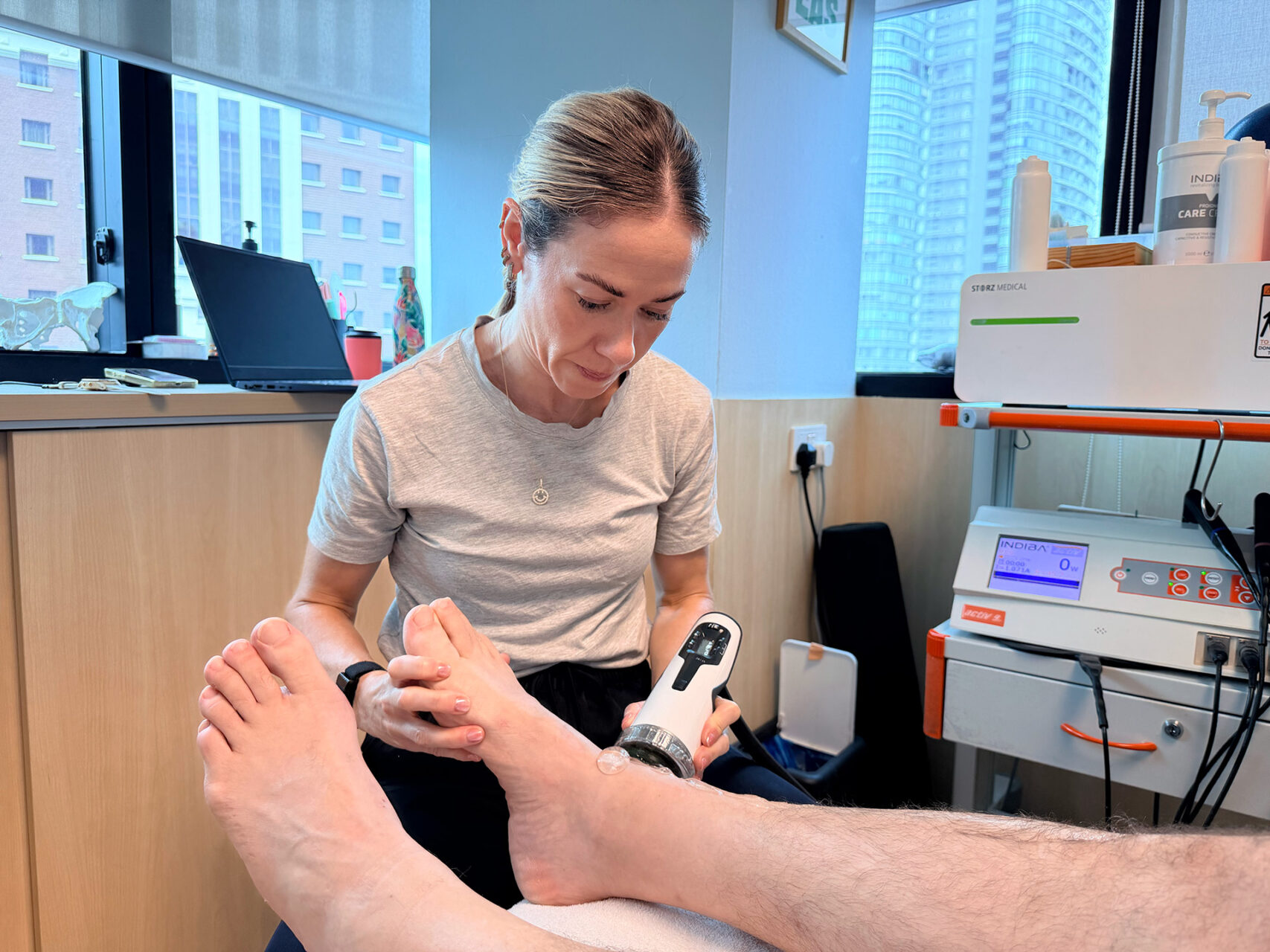
- Shockwave Therapy is not used to heal a fracture, but it may be useful when persistent pain comes from tendons or fascia around the ankle after immobilization. Focused shockwaves may be selected for deeper tendon pain, while radial shockwaves can address broader soft-tissue sensitivity.
- EMTT (Extracorporeal Magnetotransduction Therapy) may be used in selected cases to support pain modulation alongside a progressive exercise plan, particularly after surgery.
These tools can make rehab more comfortable, but they do not replace loading.

Preventing Repeat Injury after You Feel “Better”
Preventing future injuries means rebuilding your ankle beyond simple pain relief. Both sprained and broken ankle injuries need proper treatment to prevent further complications. Many re-injuries happen when patients return to sport before ankle control is restored.
This is also where the difference between a sprained ankle and a broken ankle matters in the long term. A broken ankle that heals in a cast will need rehab. A sprained ankle that “feels okay” after a week still needs progressive training. Whether sprained or broken, the ideal intervention strategy is a clear treatment plan that restores function, not just symptom relief. When properly treated, both sprained and broken ankles can heal properly.
How HelloPhysio Can Help
If you are unsure whether it is a sprained ankle vs broken ankle, an ankle pain assessment with a professional helps you avoid delays and choose the right next step. Whether you are recovering from a sprained ankle, a broken ankle, a hairline fracture, or post-surgical immobilization, HelloPhysio will assess your ankle, guide whether imaging is needed, and build a treatment plan that restores strength, mobility and support.
If you are dealing with ongoing ankle swelling, instability, or chronic ankle pain after an ankle injury, contact HelloPhysio to book a consultation for a plan you can trust.